
 Price : $450 with Free Super Saver Shipping
"This camera feels so much like my old Nikon film camera, it was love from the first moment I held it in my hand. Using a 1 Gig memory card I can now shoot 350+ "fine" quality photos without having to change out ten rolls of film...or pay the processing! And a handy battery recharger quickly restores battery capacity when needed. Even with lots of flash pictures its charge remained strong for very long periods of time. A handy icon appears in the info screen area to let you see at a glance who much power remains. I bought the D50 for a vacation to the photogenic Southwest, and this camera was more than up to the task. The fast auto-focus, the simplfied auto controls that give quick choices for portrait, landscape and full sun, cloudy, night etc. let me shoot like a pro while it was the Nikon that converted my impulses into reality. Neat. With the ability to interchange lenses, and a great Nikon Zoom lens to start, I believe this camera proves that it is the optics which are every bit as important as the pixels. My earlier digital camera has suffered sudden retirement. I have a wide carriage Epson printer and have been printing out some of the images as 12x18 prints. Even with cropping, the images look like they were taken with a medium format camera. Progress! If you like crisp and detailed images with no hint of digital-itis, this camera is a great choice. I love precisely composing pictures through the lens rather than approximating the cropping with the display screen; but I also benefit from the ability to quickly check that screen to see the results at once. Never could do that with my old SLR without a Polaroid back! Overall, this camera and lens is a real find and I do not think you can go wrong with it. Its only drawback is a short learning curve to become familiar with the many features and options it includes, and that is not really a complaint. This camera has more tricks than I will ever use!"
View This Item On Amazon
Saturday, January 12, 2008
Review : Nikon D50 6.1MP Digital SLR Camera (Body Only)
Review : Nikon D40 6.1MP Digital SLR Camera Kit with 18-135mm f/3.5-5.6G ED-IF AF-S DX Zoom-Nikkor Lens
 Price : $661.65 with Free Super Saver Shipping
Review : Nikon D80 10.2MP Digital SLR Camera Kit with 18-55mm ED II AF-S DX Zoom-Nikkor Lens
 Price : $869.88 with Free Super Saver Shipping
"So far, so good, but if you use a UV filter you will find that shots taken in low light or those involving prolonged shutter exposure will cause light to reflect off of the lenses. If it was possible for me to attach an example to this review I would attach about 100 pics I shot within the past 2 weeks. Other than that this camera is easy and fun to learn. The only drawback to camera operation is that sometimes the autofocus does not know what to lock onto if there is too much sky or solid color in the picture, which will prevent the camera from taking the picture unless you switch it to manual operation."
"i bought this camera for my girlfriend and she loves it. she is a bit of amateur photographer with a great eye and this camera is very user friendly that takes beautiful pictures. it is user friendly enough for the beginner yet has enough features to allow you to grow with it to professional. she loves it. "
View This Item On Amazon
Thursday, January 10, 2008
Review : Nikon D80 10.2MP Digital SLR Camera
 "Obviously, I am enamored with the Nikon D80. As one who has extensively used the D100, D70s, and D200, I was curious as to how the D80 would "shake out" in comparison with these fine cameras. The answer is that it does very well indeed. The most obvious improvement in D80 over the D70s and D100 is the upgrade from 6.1 to 10.2 Megapixels--the same as its "Big Brother," the D200 This is not a major issue for many users, as a 6.1 MP image (uncropped) looks essentially exactly the same as a 10.2 MP image. However, if the user intends to crop images in post-processing, the larger amount of resolution becomes important--the more megapixels the more detail when images are cropped. Shooters of wildlife, for example, will appreciate the additional resolution of the D80, as it is often necessary to photograph wildlife at a distance and then crop the image to cause the subject to dominate the frame. The other very obvious D80 improvements are the larger viewfinder and larger rear-LCD. These are very welcome improvements, also borrowed from the D200. The viewfinder is wide, bright, and a literal joy to use. Combined with the 11-point autofocus system (basically the same as that of the D200 although with some differences in options) the viewfinder makes the D80 a powerhouse camera for moving subjects, or for framing the subject in places other than the center of the image. The autofocus is fast and sure. I literally never use manual focus with the D80--the autofocus is just too good not to use for almost every conceivable situation. The 2.5 inch rear LCD is bright and vivid--a joy to use. This too, as mentioned above, is borrowed from the D200. The menu selections in the D80 closely track those of the D200 and are largely pretty intuitive for anyone who is somewhat familiar with the Nikon system. A few nits. First of all, the D80 does not have a selection for focus-priority continuous focus mode. This is unfortunate, as such an option (present on the D200) allows fast action shots using continuous-focus with surety that the subject is, in fact, in focus. Happily, this absence (which I predict and hope Nikon will correct in a later firmware revision) is not a huge loss. I have shot hundreds of images of fast-flying birds using continuous focus with the D80 and the images are almost all perfectly focused. The user can trust the D80 in continuous focus mode, focus priority or no. Nikon chose to equip the D80 with SD cards rather than CF cards. Why Nikon did this is a mystery to many of us as the D80 clearly is an upgrade to the wonderful D70s, which uses CF cards. Further, the D80 is a fantastic backup camera for D200 users, and the D200, of course, also uses CF cards rather than SD cards. CF cards would have been a more logical choice in my opinion for the D80. Fortunately, the cost of these media is dropping so fast that this is less of an issue than it would have been a few years ago. The D80 sucks up power a lot faster than the D70s. That 2.5 inch LCD entails higher power use as a price. Most users will want to own a spare battery. As to ergonomics, the D80 is terrific! I have just finished an 8 day stay on Maui, Hawaii, during which my D80 was literally always with me. The weight of the camera is low, and its bulk, reasonable. There is no digital SLR I would rather carry for an extended period than the compact D80. The placement of the various controls is excellent, and pretty intuitive. The quality of the D80 body construction is standard Nikon-Prosumer grade, which is to say, excellent albeit not as heavy-duty as the metal-body D200. Overall, the D80 is destined to become one of the great Nikon cameras that will find a place with users all over the world"
View This Item On Amazon
Sunday, January 6, 2008
Review : Nikon D40x 10.2 Megapixel
 Strengths: Very nice value for the feature set, gorgeous 2.5" LCD screen, Auto-Flash Off exposure program, Nikon takes their simplest dSLR (the D40) and adds 10.2MP resolution and 3fps! Cons: Only fully compatible with AF-S lenses, no top LCD, no second command wheel Like the D40, the D40x is designed to capture the "entry-level" dSLR user and folks migrating from point and shoot cameras. The D40x does a nice job introducing aspiring photographers into the dSLR world. It is powerful enough that it will allow most camera users new to dSLR photography to grow into the features it has. But the D40 can still be used as a super P&S - just put it in P or A mode and start shooting away! I particularly like the Auto-Flash Off feature. Instead of forcing the consumer to fumble with menus to disable the flash (for when you're in a church or museum, for example), this automatic exposure program is an easy one step process. I continue to be impressed by how Nikon designs its products. Unlike other camera companies, Nikon does not cripple its lower end products by hardwiring limits to high end components. It assembles the best components it has to come up with a complete camera to meet a particular price point. For example, all of Nikon's dSLR cameras today have 2.5" LCDs from their most expensive to their entry level dSLR. Also, the D40x shares the D80's 10.2MP resolution and matches the D80's 3 frames per second performance. Nice. So why would you buy the D40x instead of the D40? For the higher resolution (10.2MP vs 6.1MP), higher frame rate (3fps vs 2.5fps) and lower starting ISO (100 vs 200). That's it! If you crop your photos a lot, the D40x is what you want. Otherwise, the D40 should suit you just fine. What do you give up by not going up to the D80? The D80's top LCD, main LCD cover, second command wheel, flash commander mode, depth of field preview button, high speed flash sync, less focus areas, continuous AF engine, and on-demand viewfinder gridlines. Also, only AF-S lenses will have all functions work with the D40x while all AF lenses will work with the D80. Will you miss these features of the D80 by going to a D40x? It depends on the photographer. Ninety percent of photographers will be perfectly happy with the D40x while more advanced/serious photographers will want the D80 or more. Lots to love about the D40x. Nikon's image quality, as expected, shines through. And ergonomics are top notch. The D40x is Nikon's smallest and lightest dSLR but it manages to feel substantial and solidly built. I would highly recommend this camera. Good luck!
Review : Nikon D40 6.1 Megapixel
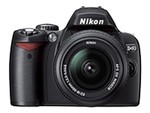 The Nikon D40 is a compact and lightweight high-performance camera that makes it possible for anyone to create stunning images with an SLR. Designed specifically for ease of use, the D40 lets you use the kind of digital and optical technologies that professionals use without the need to deal with complex functions. Whatever you shoot there is an automated Digital Vari Program that lets you achieve fantastic results in any situation. Help menus are easy to navigate and the in-camera retouch menu makes it simple to edit and enhance your images on the large, bright 2.5-inch LCD monitor. Perfect for people who want an affordable camera to explore what it is that makes SLR photography stand out, the D40 is so user-friendly that all you have to do is concentrate on the scene you want to photograph and the camera's advanced Nikon technologies will take care of the rest.
Details
Dimensions (WxDxH):
12.6 cm x 6.4 cm x 9.4 cm
Weight:
475 g
Additional Features:
text input to Exif header
Lens Features
Optical Sensor Type:
CCD
Optical Sensor Size:
15.6 x 23.7mm
Maximum Focal Length:
135 mm, 55 mm
Minimum Focal Length:
18 mm
Display:
LCD display - TFT active matrix - 2.5" - color
Flash Features
Flash Type:
Pop-up flash
Red Eye Reduction:
Yes
